Key Benefits of the OptBlue Program
Last Updated on September 4, 2026 by Dimitri Akhrin
How BAMS OptBlue Can Benefit Your Business
A Simpler Way to Accept American Express
Allowing customers to pay with credit cards gives them more flexibility at checkout and can help businesses avoid turning away a preferred payment method. But accepting cards also comes with processing costs, settlement schedules and administrative work that merchants need to manage.
American Express historically created an additional challenge because merchants often handled Amex separately from their other major card brands.
American Express OptBlue changes that model.
Eligible merchants can accept American Express through their payment provider alongside their other major card brands, making Amex acceptance easier to manage while giving providers more flexibility in the rates they offer.
For BAMS merchants, the two most immediate benefits are competitive OptBlue pricing and faster access to eligible American Express sales. But the program also simplifies reporting, settlement and account support.
TL;DR
- OptBlue makes American Express easier to manage through your existing payment provider – Eligible merchants can accept Amex alongside their other major card brands instead of maintaining a completely separate American Express processing relationship.
- The 2026 OptBlue eligibility threshold increased to $3 million in annual Amex volume – For most eligible U.S. industries, businesses with less than $3 million in estimated annual American Express charge volume may qualify. Certain industries currently have no annual charge-volume threshold.
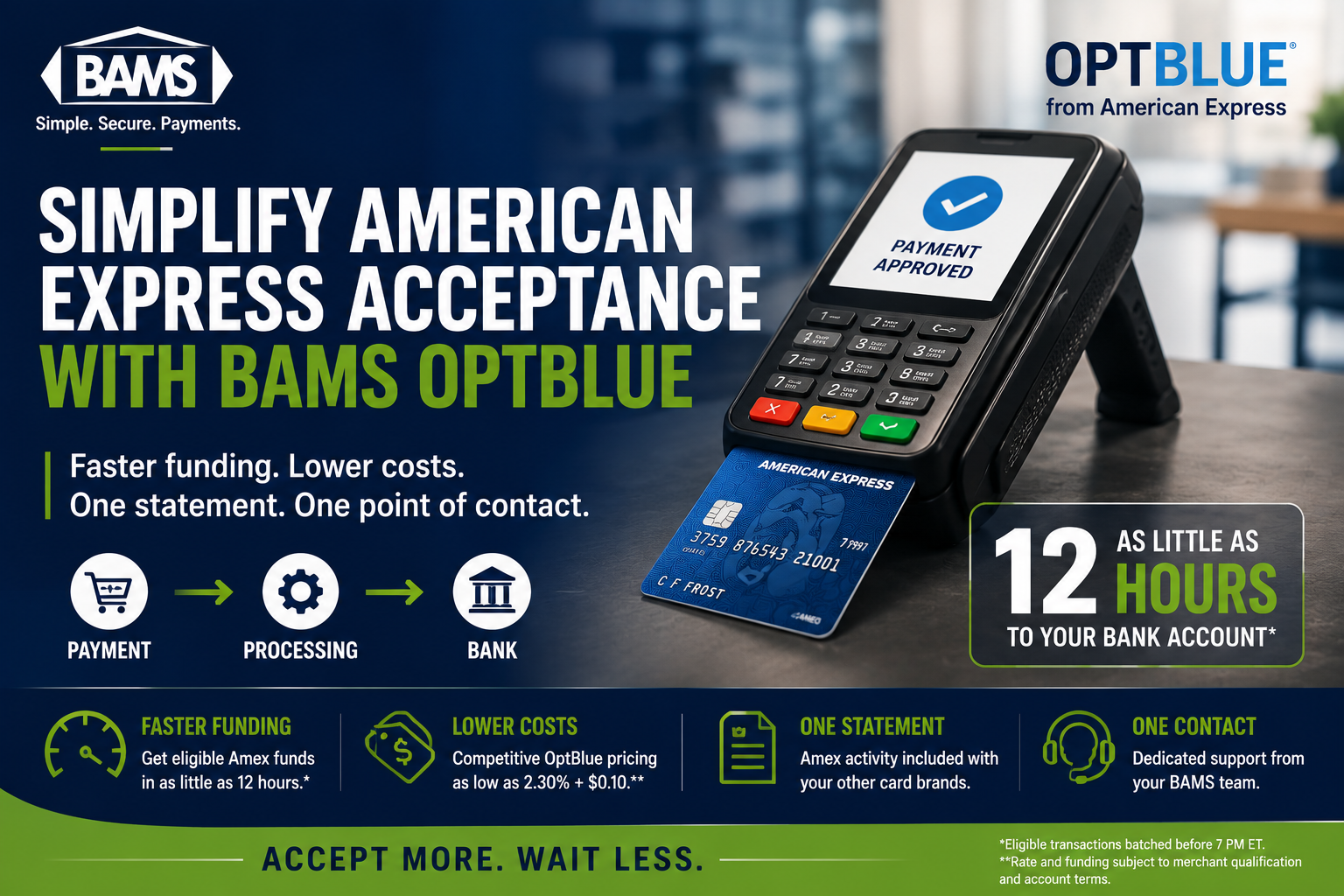
- BAMS can provide eligible OptBlue merchants with faster access to funds – Transactions batched before 7 PM ET can reach the merchant’s bank account by approximately 7 AM the following morning, allowing qualifying Amex sales to fund in as little as 12 hours.
- OptBlue pricing is set by the participating payment provider – BAMS currently advertises rates as low as 2.30% plus $0.10 per transaction with a $0 statement fee for qualifying merchants, while actual pricing depends on the business and account terms.
- OptBlue can simplify reporting, settlement and support – American Express activity can be handled through the same provider relationship as other major card brands, giving merchants a more unified deposit process, consolidated statement and single servicing contact.
Who Qualifies for OptBlue in 2026?
OptBlue was created to make American Express acceptance more accessible through participating payment providers.
The eligibility threshold changed significantly in 2026.
Effective April 17, 2026, American Express increased the standard U.S. OptBlue acquiring threshold to businesses with less than $3 million in estimated annual American Express charge volume.
This refers specifically to American Express volume, not the merchant’s total annual card-processing volume.
American Express also states that certain industry categories currently have no annual charge-volume threshold, including Charity, Education, Government, Healthcare, Insurance, Residential Rent and Utilities. Additional restrictions apply to certain industries and franchises.
This means a business could process substantially more than $3 million annually across Visa, Mastercard, Discover and American Express combined while still qualifying for OptBlue if its Amex volume remains below the applicable limit.
Quicker Turnaround
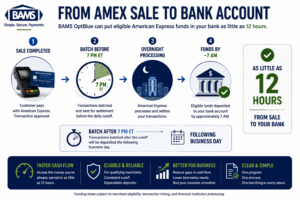
BAMS OptBlue can provide eligible merchants with access to American Express transaction funds in as little as 12 hours.
One of the biggest concerns merchants have with card processing is how long it takes for completed sales to become usable cash in the business bank account.
The original version of this article noted that traditional American Express funding could take three to five business days. BAMS still uses that timeframe when comparing its OptBlue funding program with a separate traditional Amex arrangement.
With BAMS OptBlue, eligible American Express transactions can be funded in as little as 12 hours.
BAMS currently states that transactions batched before 7 PM ET can reach the merchant’s bank account by approximately 7 AM the following morning. Transactions batched after the cutoff are generally deposited the following business day.
For businesses that regularly turn card revenue back into inventory, payroll, supplier payments or other operating expenses, that difference can have a meaningful effect on cash flow.
Why Funding Speed Matters
A completed sale is not necessarily usable cash.
A restaurant may need yesterday’s revenue to pay vendors. A retailer might need to replenish inventory. An eCommerce merchant may be funding fulfillment and advertising continuously.
The longer processed revenue remains in settlement, the more working capital the business may need elsewhere.
Faster funding does not increase revenue, but it can give merchants quicker access to revenue they have already earned.
Potentially Lower American Express Processing Fees
Another advantage of BAMS OptBlue is the way American Express pricing works.
With OptBlue, American Express provides participating payment providers with underlying wholesale pricing. The provider then sets the merchant-facing American Express rate, much like it sets pricing for other card brands.
American Express itself emphasizes this distinction: under OptBlue, the provider sets the merchant’s American Express rate.
That means merchants can compare OptBlue pricing between providers instead of assuming Amex acceptance must carry one fixed rate.
BAMS currently advertises OptBlue pricing as low as:
- 2.30% discount rate
- $0.10 per transaction
- $0 statement fee
These are “as low as” rates. Actual pricing depends on factors including the merchant’s business category, MCC/SIC code and account terms.
Be Careful Comparing Against a Single “Traditional Amex Rate”
The original article stated that a traditional American Express program charges 3.50% plus $0.35 per transaction.
That should not be treated as a universal American Express rate.
BAMS currently uses as high as 3.50% plus $0.35 per transaction as a comparison example for traditional American Express processing on its OptBlue page. Pricing for an individual merchant can vary.
The useful comparison is therefore not “OptBlue always costs X and direct Amex always costs Y.”
Instead, compare your actual effective American Express processing cost against the OptBlue offer available to your business.
One Deposit Instead of a Separate Amex Funding Stream
Faster funding is useful, but OptBlue also simplifies how American Express revenue enters the business.
American Express currently describes OptBlue as providing one convenient payment: merchants can receive Amex funds through the same provider relationship used for their other major card brands.
This reduces the need to monitor a completely separate American Express settlement process.
For accounting teams, that can make daily reconciliation easier because card activity is moving through a more unified payment environment.
One Statement for Your Major Card Brands
Traditional separate American Express processing can also create another monthly statement to review and reconcile.
OptBlue is designed to consolidate that workflow.
American Express identifies one statement as one of the core benefits of OptBlue. The merchant receives American Express transaction information through its participating provider alongside the other card brands processed through that relationship.
BAMS merchants can also use Reporting & Analytics tools to review payment activity, deposits and account information from a centralized dashboard.
That matters more as transaction volume increases. One extra statement does not sound like much, but every separate system adds another place for accounting to look when numbers need to be reconciled.
One Point of Contact for Support
OptBlue also simplifies who the merchant calls when there is a problem.
American Express describes the program around a single servicing contact through the participating provider.
Instead of maintaining one support relationship for American Express and another for Visa, Mastercard or other card activity, the merchant can work through its payment provider for the brands processed through that relationship.
For BAMS merchants, that means BAMS can serve as the primary contact for the OptBlue account.
American Express Acceptance Is Much More Common Today
The business case for accepting American Express has also changed since OptBlue was first introduced.
American Express currently reports that its cards can be accepted at 99% of U.S. locations that accept credit cards, based on February 2026 Nilson Report data.
That makes Amex acceptance far less unusual than it once was.
American Express also reports that, based on U.S. year-end network data, the average transaction size on American Express cards was 58% higher than the average on other major credit and charge card networks. Annual spend per American Express card averaged 3.1 times that of cards on the other networks.
Those figures do not mean an individual Amex customer will necessarily spend more at your particular business. They do help explain why merchants may not want to unnecessarily restrict the payment method.
BAMS OptBlue vs a Separate American Express Setup
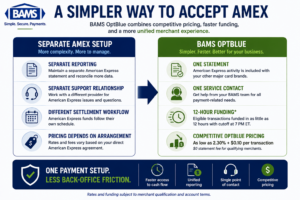
BAMS OptBlue can combine competitive American Express pricing with faster funding and a more unified merchant-account experience.
| What to Compare | Separate Amex Setup | BAMS OptBlue |
|---|---|---|
| Pricing | Depends on the merchant’s American Express arrangement. | BAMS advertises rates as low as 2.30% + $0.10 for qualifying merchants. |
| Funding | Can operate on a separate funding schedule. | Eligible transactions can fund in approximately 12 hours. |
| Statement | American Express reporting may be separate. | Amex can appear with the merchant’s other card activity. |
| Support | May involve a separate Amex relationship. | One servicing contact through the payment provider. |
| Rate setting | Depends on the specific direct arrangement. | The OptBlue provider sets the merchant-facing rate. |
Who Should Consider BAMS OptBlue?
OptBlue can be particularly useful when:
- Your customers want to pay with American Express.
- Your business qualifies under the current OptBlue volume and industry requirements.
- You want American Express activity consolidated with your other card processing.
- Faster access to Amex transaction revenue would improve cash flow.
- You want to compare your existing American Express costs against provider-set OptBlue pricing.
- Your accounting team would benefit from simpler statements and reporting.
The program should still be evaluated against your actual processing profile rather than chosen solely because an advertised rate looks lower.
Frequently Asked Questions
What is American Express OptBlue?
OptBlue is an American Express program that allows eligible merchants to accept Amex through participating payment providers instead of maintaining a completely separate direct American Express processing relationship.
Who qualifies for OptBlue in 2026?
For most eligible U.S. industries, businesses with less than $3 million in estimated annual American Express charge volume may qualify. Certain industries have no annual charge-volume threshold, and other restrictions can apply.
Did the OptBlue eligibility limit increase?
Yes. American Express increased the standard U.S. OptBlue acquiring threshold from $1 million to $3 million effective April 17, 2026.
Does the $3 million threshold mean total card-processing volume?
No. It refers to estimated annual American Express charge volume, not the merchant’s combined processing volume across every card brand.
How quickly does BAMS OptBlue fund transactions?
BAMS currently advertises funding in as little as 12 hours. Eligible transactions batched before 7 PM ET may reach the merchant’s bank account by approximately 7 AM the following morning.
What does BAMS charge for OptBlue?
BAMS currently advertises OptBlue rates as low as 2.30% plus $0.10 per transaction for qualifying merchants. Actual pricing depends on the business and account.
Who sets an OptBlue merchant’s American Express rate?
The participating payment provider sets the merchant-facing American Express rate. American Express provides underlying wholesale pricing to OptBlue providers.
Does OptBlue require a separate American Express statement?
No. One of the program’s central benefits is consolidated reporting through the merchant’s provider instead of maintaining a completely separate Amex statement.
How widely is American Express accepted in the U.S.?
American Express reports that its cards can be accepted at 99% of U.S. locations that accept credit cards, based on February 2026 Nilson Report data.
See Whether OptBlue Makes Sense for Your Business
BAMS OptBlue gives eligible merchants another way to accept American Express without maintaining a completely separate payment-processing workflow.
For qualifying businesses, BAMS currently combines OptBlue rates as low as 2.30% plus $0.10 with unified reporting, a waived statement fee and funding in as little as 12 hours. :contentReference[oaicite:2]{index=2}
The exact savings depend on what your business pays today.
If you are interested in BAMS OptBlue, request a free price comparison to review your current processing costs and see how the program compares.